When Should You Take a Personal Loan vs Credit Card Loan?
When you need quick access to funds, two common borrowing options are a personal loan and a credit card loan. While both provide financial assistance without requiring collateral, they differ in terms of interest rates, repayment periods, loan amounts, and eligibility. Choosing the right option depends on your financial needs, repayment ability, and the purpose of borrowing.
Understanding the differences between a personal loan and a credit card loan can help you make an informed decision and avoid unnecessary financial stress.
What Is a Personal Loan?
A personal loan is an unsecured loan offered by banks, non-banking financial companies (NBFCs), and digital lenders. Since it does not require collateral, approval is based on factors such as your income, employment status, credit score, and repayment history.
Personal loans are generally used for:
- Medical emergencies
- Home renovation
- Wedding expenses
- Travel
- Higher education
- Debt consolidation
Borrowers receive the approved amount as a lump sum and repay it through fixed monthly EMIs over a chosen tenure.
What Is a Credit Card Loan?
A credit card loan is a pre-approved loan offered to eligible credit card holders. It is usually based on your credit limit, repayment history, and relationship with the card issuer.
Unlike regular credit card purchases, a credit card loan provides either a lump-sum amount or converts large purchases into EMIs. Since the lender already has your financial information, approval is often instant with minimal documentation.
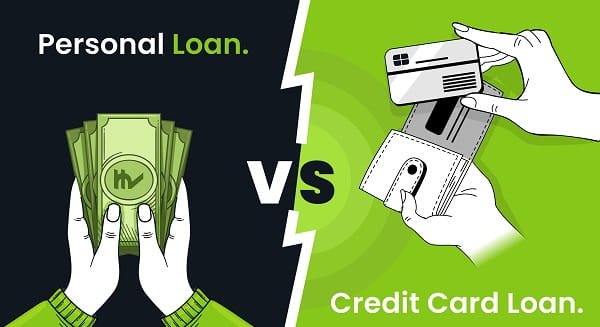
Personal Loan vs Credit Card Loan: Key Differences
| Feature | Personal Loan | Credit Card Loan |
| Loan Amount | Higher borrowing limits | Limited by available credit limit |
| Approval | Based on income and credit profile | Usually pre-approved for existing cardholders |
| Interest Rate | Often lower for eligible borrowers | May be higher depending on the offer |
| Repayment Tenure | Typically 1–7 years | Usually 6–60 months |
| Documentation | Income and identity verification required | Minimal or no additional documentation |
| Processing Time | A few hours to several days | Often instant |
When Should You Choose a Personal Loan?
A personal loan is usually the better option in the following situations:
1. Need a Large Loan Amount
If you’re planning a wedding, home renovation, or major medical treatment, a personal loan generally offers higher borrowing limits than a credit card loan.
2. You Want Lower Monthly EMIs
Longer repayment tenures allow you to spread the repayment over several years, making monthly EMIs more affordable.
3. You Need Funds for Planned Expenses
Personal loans are suitable for planned financial commitments where you know the required amount in advance.
4. You Want to Consolidate Debt
If you have multiple high-interest debts, combining them into a single personal loan can simplify repayment and may reduce your overall interest burden.
5. You Have a Good Credit Score
Applicants with strong credit scores often qualify for lower interest rates and better loan terms, making a personal loan a cost-effective borrowing option.
When Should You Choose a Credit Card Loan?
A credit card loan can be a suitable choice in the following cases:
1. You Need Money Urgently
Since most credit card loans are pre-approved, funds can often be disbursed quickly without lengthy documentation or approval procedures.
2. You Need a Small Loan
For relatively smaller expenses, such as emergency travel or short-term cash needs, a credit card loan may be sufficient.
3. You Already Have a Pre-Approved Offer
Banks frequently provide attractive pre-approved loan offers to existing credit card customers, sometimes with competitive interest rates and flexible repayment options.
4. You Want Minimal Documentation
Because the lender already has your KYC and financial details, the application process is usually simple and paperless.
5. You Can Repay Quickly
If you can comfortably repay the loan within a shorter period, a credit card loan can be a convenient financing option.
Factors to Consider Before Choosing
Before deciding between a personal loan and a credit card loan, evaluate the following:
1. Compare Interest Rates
Even a small difference in interest rates can significantly affect the total repayment amount over the loan tenure.
2. Check Processing Fees
Look beyond the interest rate and consider processing charges, foreclosure fees, late payment penalties, and other applicable costs.
3. Your Repayment Capacity
Borrow only what you can comfortably repay. Missing EMIs may affect your credit score and future borrowing ability.
4. Loan Tenure
A longer tenure reduces monthly EMIs but increases the total interest paid. Choose a repayment period that balances affordability and overall cost.
5. Consider the Purpose
Large, long-term financial needs generally suit personal loans, while smaller, urgent expenses may be better served by a credit card loan.
Which Option Is Better?
There is no one-size-fits-all answer. The better option depends on your financial situation and borrowing needs.
A personal loan is generally more suitable if:
- You need a higher loan amount.
- You want longer repayment flexibility.
- You prefer predictable EMIs.
- You qualify for competitive interest rates.
A credit card loan may be the better choice if:
- You need funds immediately.
- Your borrowing requirement is relatively small.
- You already have a pre-approved offer.
- You can repay the amount within a shorter timeframe.
Final Thoughts
Both personal loans and credit card loans are useful financial tools when used responsibly. A personal loan is typically ideal for larger expenses and long-term repayment, while a credit card loan offers speed and convenience for smaller, short-term financial needs.
Before borrowing, compare interest rates, fees, repayment terms, and your own financial capacity. Selecting the right loan product can help you meet your financial goals while keeping borrowing costs under control and protecting your long-term financial health.