Gurgaon vs Noida Real Estate Market: Which Is Better for Investment?
Gurgaon and Noida are two of the strongest real estate markets in the National Capital Region. Both have seen substantial residential development, infrastructure expansion and price appreciation, but they offer different opportunities to investors.
Gurgaon, officially Gurugram, is a premium corporate and residential market supported by multinational companies, IT firms, Global Capability Centres, consulting companies and financial services. Its major strengths are high rental demand, strong resale activity and a well-developed luxury housing market.
Noida offers a comparatively lower entry cost, planned infrastructure, a growing IT and commercial base and strong long-term development potential. The operational Noida International Airport, Yamuna Expressway and continued expansion towards Greater Noida have further strengthened its investment outlook.
Interestingly, Noida has slightly outperformed Gurgaon in percentage price appreciation since 2019. Average residential prices in Noida increased around 125% between 2019 and Q2 2026, compared with approximately 117% in Gurgaon.
So, which city offers the better investment opportunity? The answer depends on whether the investor prioritises capital appreciation, rental income, affordability, premium housing or long-term infrastructure-led growth.
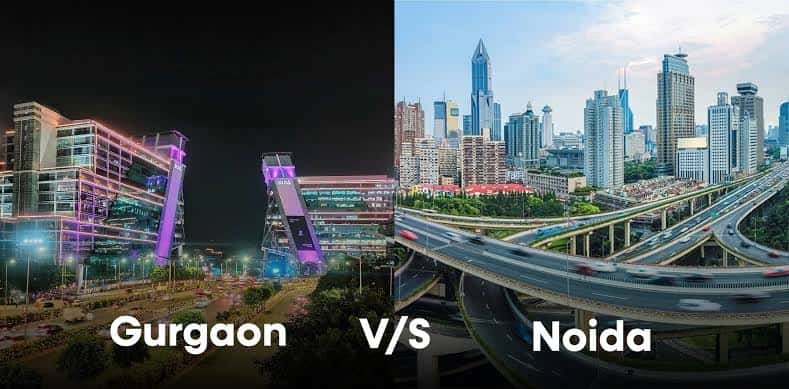
Gurgaon vs Noida Real Estate: Quick Comparison
| Factor | Gurgaon | Noida |
| Average residential price, Q2 2026 | Around ₹13,350 per sq. ft. | Around ₹10,780 per sq. ft. |
| Price appreciation, 2019-Q2 2026 | Around 117% | Around 125% |
| Indicative gross rental yield | Around 4.3% | Around 3.9% |
| Market positioning | Premium and luxury-heavy | Mid-premium to premium |
| Major demand drivers | Corporate offices, IT, GCCs, BFSI | IT/ITES, electronics, commercial and industrial growth |
| Major infrastructure | Dwarka Expressway, SPR, NH-48, metro expansion | Noida Expressway, Yamuna Expressway, metro, international airport |
| Entry cost | Higher | Comparatively lower |
| Rental demand | Very strong | Strong in established corridors |
| Best suited for | Rental income and premium investment | Value buying and long-term appreciation |
1. Gurgaon Real Estate Market: Premium Growth Driven by Employment
Gurgaon has developed into one of India’s leading corporate hubs. Cyber City, Golf Course Road, Golf Course Extension Road, Udyog Vihar and other commercial districts host thousands of companies and support a large population of professionals.
This employment base creates consistent demand for both rental and owner-occupied housing.
Average residential prices in Gurgaon increased from around ₹6,150 per sq. ft. in 2019 to approximately ₹13,350 per sq. ft. by Q2 2026. This represents appreciation of about 117%.
The market has also become increasingly premium. Luxury apartments, gated communities and branded residences have attracted senior corporate executives, entrepreneurs, NRIs and high-net-worth buyers.
Where Gurgaon Has an Advantage
Gurgaon is particularly attractive for investors seeking:
- Strong corporate rental demand
- Premium and luxury housing
- Better rental yields
- Good resale liquidity
- Established employment corridors
- Proximity to Delhi and IGI Airport
- Projects from major national developers
Its biggest disadvantage is pricing. Many established corridors have already appreciated sharply, so investors need to be selective rather than assuming that every project will continue delivering similar returns.
2. Noida Real Estate Market: Strong Appreciation with Better Affordability
Noida has changed dramatically over the past few years. It is no longer simply a lower-cost alternative to Gurgaon.
The city now has premium residential communities, major commercial developments, IT offices, expressway connectivity and expanding infrastructure.
Average residential prices rose from approximately ₹4,795 per sq. ft. in 2019 to about ₹10,780 per sq. ft. in Q2 2026. This represents appreciation of around 125%, slightly higher than Gurgaon during the same period.
The development of Noida International Airport has further improved the long-term outlook for Noida, Greater Noida and areas along the Yamuna Expressway.
Where Noida Has an Advantage
Noida is particularly suitable for investors looking for:
- Comparatively lower acquisition cost
- Long-term capital appreciation
- Larger property for the same budget
- Planned sectors and wider roads
- Airport-led development
- IT and commercial employment
- Good choices across mid-premium and premium housing
The city’s biggest opportunity lies in combining existing employment demand with future infrastructure-led development.
3. Which City Is Better for Capital Appreciation?
Slight Edge: Noida
Recent historical performance gives Noida a small advantage.
Between 2019 and Q2 2026:
- Noida: approximately 125% appreciation
- Gurgaon: approximately 117% appreciation
However, investors should not assume that Noida will automatically continue outperforming Gurgaon.
Gurgaon has a stronger established corporate ecosystem and limited supply in some prime locations. Noida has more room for infrastructure-led expansion and a lower average entry price.
For investors wanting established-demand appreciation, Gurgaon remains attractive.
For investors willing to hold property for seven to ten years and benefit from new infrastructure and economic expansion, carefully selected Noida locations may provide greater upside.
4. Which City Is Better for Rental Income?
Winner: Gurgaon
Gurgaon has the stronger rental market.
Indicative gross residential rental yields are around:
- Gurgaon: 4.3%
- Noida: 3.9%
Gurgaon’s advantage comes largely from its large corporate workforce. Properties located near Cyber City, Golf Course Road, Golf Course Extension Road and other employment hubs attract professionals and senior executives.
Noida also has healthy rental demand, especially around established sectors and the Noida-Greater Noida Expressway. However, tenant demand can vary more significantly across sectors.
Investors should always calculate net rental yield after accounting for maintenance charges, vacancy, brokerage, furnishing expenses, property tax and repairs.
5. Affordability: Noida Has the Advantage
Noida clearly offers a lower average entry price.
With Gurgaon averaging around ₹13,350 per sq. ft. compared with approximately ₹10,780 per sq. ft. in Noida, investors can generally obtain more property for the same budget in Noida.
A buyer may be able to:
- Purchase a larger apartment
- Choose a better configuration
- Enter a more established project
- Reduce dependence on a large home loan
- Keep funds available for registration and interiors
Prime Gurgaon locations such as Golf Course Road and parts of Golf Course Extension Road can be especially expensive.
Noida therefore remains more accessible for first-time investors and buyers with moderate budgets.
6. Infrastructure and Growth Corridors
Infrastructure is one of the biggest property-growth drivers in both cities.
Gurgaon
Important infrastructure includes:
- Dwarka Expressway
- NH-48
- Southern Peripheral Road
- Golf Course Extension Road
- Existing metro and Rapid Metro connectivity
- Upcoming Gurugram Metro expansion
Dwarka Expressway has particularly strengthened residential development in New Gurgaon and improved connectivity towards Delhi and the airport.
The planned metro corridor connecting Millennium City Centre with Cyber City should further improve connectivity across important parts of Gurgaon.
Noida
Major infrastructure includes:
- Noida-Greater Noida Expressway
- Yamuna Expressway
- DND connectivity
- Blue Line and Aqua Line metro
- Eastern Peripheral Expressway access
- Noida International Airport
The airport is now a major long-term economic catalyst rather than merely a proposed project.
However, investors should not buy property simply because it is marketed as being “near the airport.” Actual distance, road connectivity, residential demand and employment generation remain important.
7. Supply and Market Activity
Gurgaon currently has stronger new-project activity, particularly in premium and luxury housing.
This indicates strong developer confidence but also creates a risk of oversupply in some emerging corridors.
If several similar projects are completed in the same area at the same time, investors may face greater competition for both tenants and resale buyers.
Noida’s supply is also expanding, particularly in premium developments and areas influenced by expressway and airport infrastructure.
In both cities, investors should examine:
- Number of upcoming projects
- Current occupancy
- Unsold inventory
- New launches nearby
- Expected possession dates
A property market can be growing strongly while an individual micro-market suffers from excessive supply.
8. Which City Offers Better Resale Liquidity?
Advantage: Gurgaon
Gurgaon generally offers better resale liquidity in established premium markets.
Its large population of corporate professionals, HNIs and investors creates a wider buyer base for good projects.
Properties from reputed developers located close to employment hubs generally have stronger resale demand.
Noida also has an active resale market, particularly in established sectors and along the Expressway.
However, resale performance can differ considerably between a completed, occupied residential society and a peripheral project that still depends heavily on future development.
For investment purposes, project-level liquidity is more important than the popularity of the city itself.
9. Key Risks Investors Should Consider
Neither Gurgaon nor Noida should be considered a risk-free property market.
Gurgaon Risks
Investors should examine:
- High property valuations
- Large luxury housing supply
- Water availability
- Traffic congestion
- Drainage and waterlogging
- High maintenance charges
- Premium pricing around new launches
- Dependence on future infrastructure in emerging sectors
Buying an expensive property after most of the appreciation has already occurred can reduce future returns.
Noida Risks
Important risks include:
- Developer execution history
- Property documentation
- Authority-related dues
- Low occupancy in peripheral areas
- Oversupply in selected sectors
- Distance from employment hubs
- Speculative pricing around airport-linked areas
Investors should particularly avoid assuming that every property along the Yamuna Expressway will automatically benefit equally from the airport.
10. Gurgaon vs Noida: Which Is Better for Different Investors?
For Capital Appreciation
Noida has the recent historical edge.
Its lower entry price and major infrastructure development provide further long-term potential.
For Rental Income
Gurgaon
Its corporate workforce and higher rental yield make it the stronger rental market.
For a Lower Investment Budget
Noida
Average property prices remain lower, giving investors greater choice.
For Luxury Real Estate
Gurgaon
It has a deeper premium and luxury market with greater demand from wealthy buyers and NRIs.
For Infrastructure-Led Growth
Noida
Noida International Airport, Yamuna Expressway and continuing development towards Greater Noida provide significant long-term growth potential.
For Corporate Rental Property
Gurgaon
Locations close to major office districts generally have stronger tenant demand.
For First-Time Investors
Noida
Its lower entry cost can make property investment financially easier.
For NRI Investors
Gurgaon is attractive for premium rental properties and branded developments, while Noida may appeal to NRIs seeking lower acquisition costs and long-term appreciation.
11. What Should You Check Before Investing?
Before purchasing property in either city, examine:
- RERA registration
- Legal title
- Developer’s delivery record
- Construction progress
- Actual occupancy
- Existing resale prices
- Current achievable rent
- Maintenance charges
- Water supply
- Drainage and flood history
- Road and metro connectivity
- Distance from employment centres
- Nearby competing projects
- Unsold inventory
- Total acquisition cost
Do not judge a project only by its quoted price per square foot. Registration, parking, maintenance deposits, club charges and other costs can significantly increase the final investment amount.
Final Verdict: Gurgaon or Noida?
Both cities offer strong real estate investment opportunities, but they suit different investors.
Gurgaon is better for investors seeking premium property, strong corporate rental demand, higher rental yield and better resale liquidity. Its large employment base and established business districts provide consistent housing demand.
However, Gurgaon also requires a substantially higher investment, particularly in its best-performing locations.
Noida is better for investors seeking a comparatively lower entry price and long-term infrastructure-led appreciation. Its residential market has already delivered impressive price growth, while the airport, expressways and expanding commercial ecosystem can support future development.
The choice can therefore be simplified:
Choose Gurgaon if: You have a higher budget, want rental income, prefer established premium locations and value resale liquidity.
Choose Noida if: You want more property for your budget, are focused on long-term capital appreciation and can hold through the next phase of infrastructure development.
For a five-to-seven-year investment horizon and a larger budget, Gurgaon remains highly attractive.
For investors prepared to hold for seven to ten years while targeting infrastructure-led growth, carefully selected Noida locations may provide a stronger price-to-growth opportunity.
Ultimately, choosing the right sector, project, developer and entry price matters more than choosing Gurgaon or Noida alone.